You’re an email marketer, an eCommerce store owner, a marketing manager or an eCommerce web developer looking to learn how to use email to increase orders. You’re probably already sending newsletters and maybe even sending abandoned cart emails, but are you sending reward emails? Read More
Need a crash course on eCommerce email marketing best practices? Good thing you’re here.
Remarkety was invited to speak at WeWork about the best practices for email marketing, types of behavioral eCommerce emails and tracking email ROI.
You can flip through the full deck here.
While people may not view email as more exciting than Pinterest or Facebook or Instagram, email is used a lot.
WSJ reported people at work check their email 74 times a day on average.
That’s not all. Read More
Thought you knew everything there is to know about how to use Remarkety to send your eCommerce emails? You are in for a surprise.

We’ve added six new (and simple!) features that will make your life with email marketing easier. And more fun, too! Read More
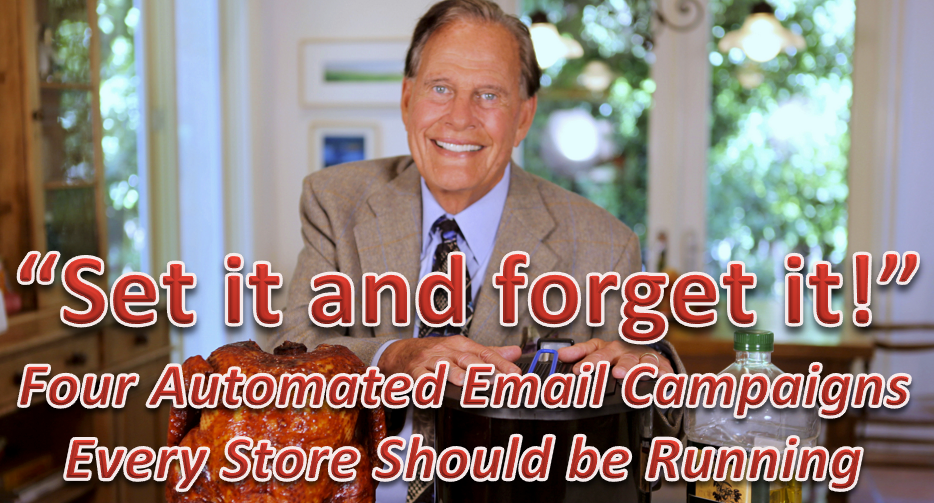
This genius slogan was once created for a genius product, the Ronco Rotisserie Oven. The chant “Set it and forget it!” reverberated through the studio audience with a little help from Ronco inventor Ron Popeil.
This whole “set it and forget it” chant is also perfectly applicable to the eCommerce world. More specifically, automated emails. Now I know what you’re thinking to yourself.
How could I ever compare to Ron Popeil?
And the answer is, you can’t. With those pale blue eyes, winning smile and mind for invention, there’s really no comparison.
We can’t all be Popeils. But we CAN take a page from his book and use four email marketing campaigns that live up to his mantra. Read More
Recently I read a nice article by Tom Koletas, which speaks about the ways marketers can make account-based marketing work for their unique needs. This made me think that with Remarkety, the lives of marketers are so much easier.

But first, what is Account-Based Marketing (or ABM)? According to Wikipedia, it is a strategic approach that organizations consider and communicate with individual prospects or customer accounts as markets-of-one. In other words, creating account-based marketing campaigns means creating personalized messages/emails to customers based on their history with your brand or shop. Read More
85% of blog posts and articles about email marketing start with boring facts. Here’s one, “did you know that it is 7 times more expensive to acquire a new customer than it is to keep a current one?“

Here’s another one, “loyal customers are worth up to 10 times as much as their first purchase.”
You still with me? Read More
We’ve touted coupons and other incentives as a great way to grow sales here and here. Coupons are extremely effective at coercing customers to finish checking out after abandoning their cart, pushing them to place new orders and winning them back after a period of no purchase.

Thing is, not all brands believe in coupons or discounts because they’re not trying to give away the farm. At first you might be thinking, who doesn’t believe in coupons or discounting products? (See JC Penny) And what does giving away the farm even mean?
Last year we asked you how we could make Remarkety better and you said newsletters. You’re welcome. Then a couple of months ago, you wanted ‘how to’ email marketing videos.  You wanted to know the best types of conditions and segmentations for different types of email campaigns. You wanted to know how to be email marketing experts.
And you know what? We thought this was a pretty darn good idea. Read More
If you’re not already running an inactive customer email campaign, let’s talk because you’re missing out on some serious sales. Hear me out, “eCommerce stores using Remarkety to send inactive customer email campaigns have up to a 15% purchase rate“.
Yes, that’s a 15% purchase rate.
These emails are designed to bring customers back to your website after a certain period of inactivity or no purchases. Without these emails, you’re missing out on a big chunk of potential sales because a 15% purchase rate is nothing to sneeze at.
And just to clarify, we define purchase rate as the number of people who placed an order after receiving an email. Considering how many inactive customers you have, that 15% purchase rate sounds pretty sweet, no?
Download the eBook